How to Identify Antique Furniture
Updated October 1, 2026 · 8-minute read
To identify antique furniture, look at how it was made before you look at how it looks. Pull out a drawer and check the joints. Look at the back and the underside for saw marks. Check the screws and nails, and look for a maker's label. Style tells you what period a piece is copying. Construction tells you when it was actually made, and the two are often a century apart.
This guide walks through each check in the order a dealer would do them, using nothing more than your eyes, your hands and a torch. If you would rather start with a quick answer, photograph it with Antique Snap and come back here to check the details yourself.
One definition first. In the trade, "antique" usually means at least 100 years old. "Vintage" is younger, roughly 20 to 99 years. A 1950s sideboard can be valuable, but it isn't an antique yet.
Start with the drawers
Drawers are the best place to begin because they were built to be useful, not to be looked at, so makers rarely bothered to disguise how they were put together.
Dovetail joints
Look at the corner where the drawer front meets the side. Most good furniture uses dovetail joints there: interlocking wedge shapes that hold the corner together. Hand-cut dovetails are a little uneven. There are usually only a few of them, the narrow parts are very thin, and you can often see a faint scratched line where the cabinetmaker marked how deep to cut. Machine-cut dovetails are all the same size and evenly spaced. Machines took over this job in the second half of the 1800s, so neat, identical dovetails usually point to the late 19th century or later.
You may also find a joint that looks like a row of half-moons and pegs. This is the Knapp joint, a machine-made joint patented in the United States in 1867 and used for roughly thirty years. If you see it, you have a good date range straight away.
The drawer bottom
Older drawer bottoms are usually solid wood, often thick and with the edges thinned down so they slide into a groove. The grain normally runs from side to side, and old boards have often shrunk and pulled away a little. A thin plywood drawer bottom generally means the 20th century, unless it is a later replacement.
Read the saw and tool marks
Turn the piece around or tip it over and look at surfaces nobody was meant to see: the back boards, the underside of a tabletop, the inside of a carcass.
- Straight, slightly uneven saw lines come from a hand saw or an early pit saw.
- Curved, arc-shaped marks come from a circular saw. These became common in the middle of the 1800s, so they suggest a later date.
- Gentle ripples you can feel with your palm on a back board are the marks of a hand plane. A surface that is perfectly flat and smooth everywhere was probably machine planed.
Wood also tells you its age through shrinkage. Timber shrinks across the grain over many decades but hardly at all along it. A genuinely old round tabletop is often slightly oval when you measure it both ways, and old panels can show small gaps or cracks where they have shrunk inside their frames.
Check the screws, nails and hardware
Fixings changed with manufacturing, which makes them handy for dating. Remember that screws and handles are often replaced over the years, so look for several clues that agree.
- Handmade screws, used until around the 1840s, have slots that are a little off-center, uneven threads and blunt ends. Later machine-made screws are uniform with pointed tips.
- Phillips-head screws (the cross-shaped ones) came into use in the 1930s. If they hold an original part together, the piece is 20th century, or it has been repaired.
- Nails moved from hand-forged, square and tapered nails in the 1700s, to machine-cut nails with a rectangular shape through most of the 1800s, to round wire nails from about the 1890s.
- Handles and knobs are the parts most often swapped. Look inside the drawer front: extra holes or the outline of an older handle mean the hardware you see isn't the first set.
Look at the wood, inside and out
Makers saved expensive wood for the parts you see. Drawer sides, backs and inner frames were usually made from cheaper local wood such as pine, poplar or oak. On an old piece these hidden surfaces have darkened naturally to a deep honey or brown color just from contact with the air. Bright, pale, fresh-looking wood inside an "old" chest is a strong sign of later work.
Veneer is a thin sheet of good wood glued over a plainer base. Old veneer was cut by hand and is noticeably thicker than modern veneer, which can be paper thin. Particle board or MDF anywhere in the structure means the piece was made in the second half of the 20th century or later.
Search for labels, stamps and marks
Furniture is marked far less often than silver or porcelain and pottery, but it is always worth a look. Check inside drawers, on the back panel, under the seat rail of chairs and under tabletops. You might find a maker's paper label, a stamped name, a retailer's label, a stencilled model number or chalk marks from an old sale. A label with a maker's name gives you something specific to search for. Be aware that labels can be copied or moved from one piece to another, so the label should agree with the construction.
Use style as a clue, not proof
Legs and feet are the quickest style clues. Here is a rough timeline for English and American furniture:
- Queen Anne, about 1720 to 1760: curved cabriole legs ending in a simple pad foot.
- Chippendale, about 1750 to 1790: cabriole legs with a ball-and-claw foot, plus carved backs on chairs.
- Hepplewhite and Sheraton, about 1785 to 1820: slim, straight, tapering legs and lighter shapes.
- Victorian, 1837 to 1901: heavier forms, more carving, balloon-back chairs and lots of mahogany and walnut.
- Arts and Crafts, about 1880 to 1920: plain, solid oak with the joints left on show.
The catch is that every one of these styles was copied later. "Chippendale style" dining chairs were made in huge numbers in the 1920s and are still made today. That's why the construction checks above come first. A piece can look 1760 and be built 1930.
Antique or reproduction?
Honest reproductions are not fakes, they are just younger. Problems start when a newer piece is made to look old. These are the usual giveaways:
- Wear in the wrong places. Real wear shows where hands and feet go: drawer edges, chair arms, the front stretcher of a chair. Wear spread evenly over the whole piece, or dents and scratches in odd places, often means artificial distressing.
- Worm holes that go nowhere. Real woodworm tunnels wander along the grain. Holes drilled to imitate them go straight in.
- All the hardware matches perfectly on a piece that should be 200 years old, with no sign of repairs.
- A top and base that don't belong together. Dealers call this a "marriage". Check that the wood, color and wear of the two halves match, and that the back boards line up.
Condition matters a lot for value. An untouched original finish usually sells for more than a refinished one, so don't strip or polish a piece before you know what it is. Our guide to what your antique is worth explains how condition affects price.
That's a lot to check on one chest of drawers
Done properly, the checks above take an hour or two per piece, and that's before you start searching for similar pieces to price it. The hardest part for most people is knowing what to call what they are looking at. You can't search for a "bow-front chest on bracket feet" if you don't know that's what it is. The same method works on any antique, and our five-step identification guide covers it for every category.
Antique Snap runs the same checks from a photo. It reads the shape, the wood, the joints and the wear, names the piece and its period, and shows an estimated value range based on similar pieces for sale right now, in about fifteen seconds.
Not sure what you're looking at?
Photograph the piece and the drawer joints. Antique Snap tells you what it is, roughly when it was made and what similar pieces sell for. Free to try, no account needed.
Download on theApp StoreHow to identify a piece of furniture from a photo
- Photograph the whole piece from the front in good light, with nothing in front of it.
- Add a close-up of a drawer joint or the back panel. These details help tell a period piece from a later copy.
- Read the report. You get the name, style, period, materials, a rarity class and an estimated value range with a confidence score. If the score is under 50%, take another photo of the construction details.
- Check the similar pieces listed on Etsy, eBay and at auction houses to see how yours compares.
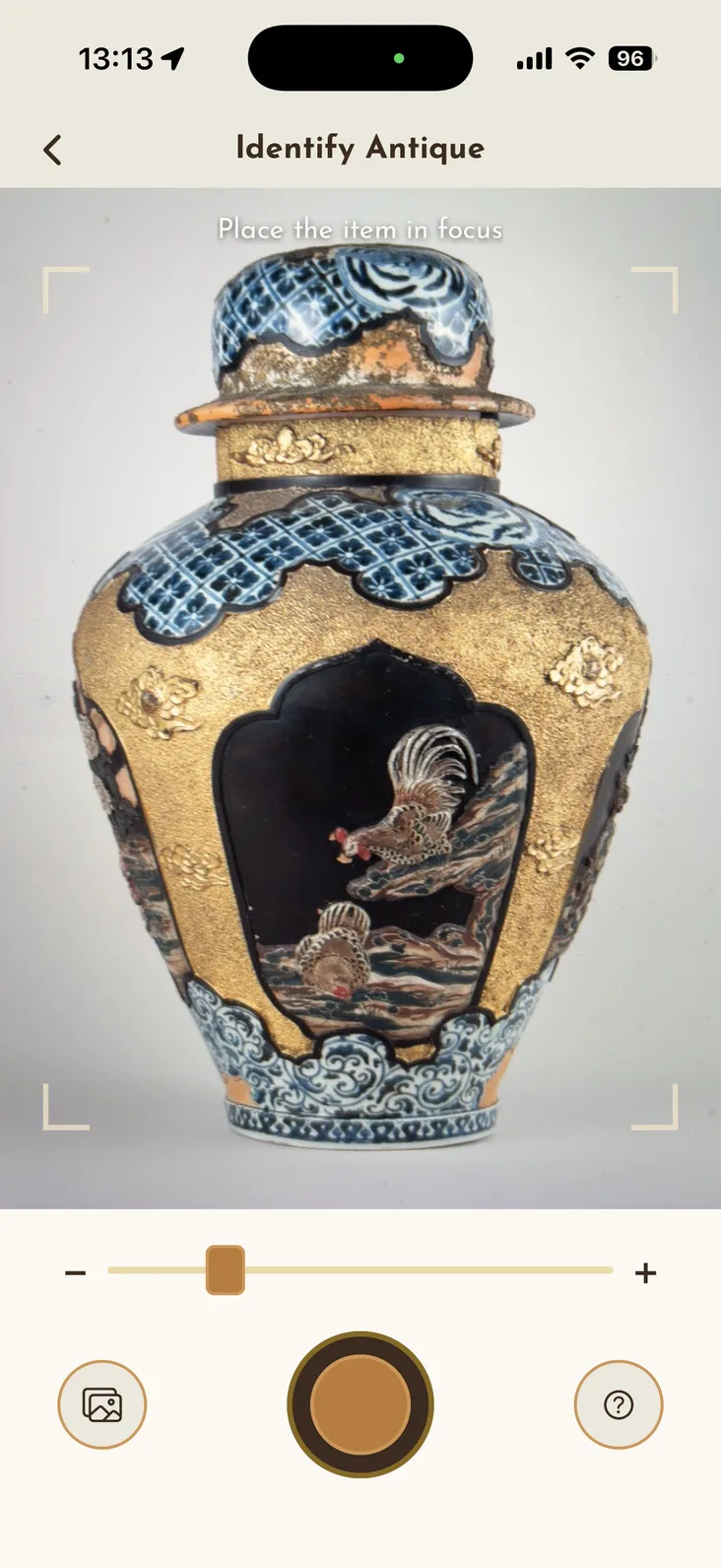


Values in the app are AI-generated estimates, not certified appraisals. They are based on similar items listed for sale at the time of the search. For insurance, probate or a sale, consult a qualified appraiser. If you are deciding between apps, our antique value app guide explains how to read the range you get.
Frequently asked questions
Check how it was built. Uneven, hand-cut dovetails in the drawers, solid wood drawer bottoms, hand saw or plane marks on the back, handmade screws or cut nails, and naturally darkened wood on hidden surfaces all point to age. Neat machine dovetails, plywood, Phillips screws and particle board point to the 20th century. The five-step method explains the same checks for other antiques.
Usually at least 100 years. That's the common definition used by dealers and auction houses, and it is also the age US customs uses for antiques. Furniture between about 20 and 99 years old is normally called vintage. Plenty of vintage furniture, mid-century design in particular, is valuable, it just isn't antique yet. Browse our other guides for more categories.
Legs and feet are the quickest clue: pad feet for Queen Anne, ball-and-claw feet for Chippendale, slim tapered legs for Hepplewhite and Sheraton, heavy carving for Victorian. But styles were copied for generations, so style only tells you what a piece imitates. Use joints, saw marks and screws to date it, and check our identifier app guide if you want a faster answer.
Value depends on age, maker, quality, condition and current demand. Original finish, original hardware and a known maker all help. Some large, plain "brown furniture" sells for less today than it did decades ago, while good mid-century pieces have gone up. Look up what similar pieces have actually sold for, as explained in our guide to what your antique is worth.
Yes, if the photo shows enough. A clear front view plus a close-up of a drawer joint or the back gives an app much more to go on than one dim photo. Antique Snap returns the name, period, materials and an estimated value range with a confidence score, so you can tell how sure it is. See how app values work.
Find out what that old dresser really is.
Free to try · No account needed · Cancel anytime
Download on theApp Store
On your computer? Scan with your iPhone camera to get the app.