The Antique Identifier App That Works From One Photo
Updated August 9, 2026 · 8-minute read
An antique identifier app should do one thing well: look at a photograph of an object and tell you what it is, where and when it was made, and what it's worth today. That is exactly what Antique Snap does. Point your camera at the thing you can't name, and in about fifteen seconds you get its name, origin, period, materials, a rarity class, and an estimated value range built from comparable pieces listed on Etsy, eBay and auction houses right now — each result with a confidence score that tells you how firmly the evidence supports it.
No account, no sign-up, no typing a description of a chair leg you don't have the vocabulary for. If that's all you needed to know: get Antique Snap on the App Store. If you want to understand what a good antique identification app actually has to do under the hood — and how to judge whether any app is doing it — read on.
What identifying an antique actually takes: the five checks
Whether it's done by a dealer at a fair, an auction-house specialist, or software, every credible identification runs the same five checks. This is the manual method — and it's also the checklist for judging any antique identifier app, because an app that skips one of these is guessing.
1. Marks, hallmarks and signatures
The fastest route to certainty. Silver carries assay marks (a lion passant for English sterling, "925" for continental); porcelain carries printed or impressed backstamps on the base; furniture may hide a maker's label in a drawer or on the back panel; paintings carry signatures and gallery stamps. The catch: there are tens of thousands of documented marks, they repeat across eras, and forgers copy the famous ones. Reading a mark means finding it, photographing it clearly, and matching it against the right reference — a genuine struck hallmark shows crisp, sharp edges, while a cast fake looks soft and slightly raised.
2. Construction and materials
Objects tell on themselves. Hand-cut dovetails are irregular; machine-cut ones (post-1860s) are perfectly even. Old mirror glass waves and spots; old screws have off-centre slots; early plastics like Bakelite feel heavier than modern resin. Materials date a piece even when marks are missing — which is most of the time.
3. Style and period
Every era leaves a silhouette: Georgian restraint, Victorian ornament, Art Nouveau's whiplash curves, Art Deco geometry, Mid-Century's teak-and-taper. Style narrows the window fast, but it's also where reproductions live — a "Victorian" chair made in 1985 has Victorian lines and modern staples. Style evidence only counts alongside construction evidence.
4. Condition, patina and honest wear
Age accumulates in predictable places: handles polish where hands go, chair stretchers wear where feet rest, brass darkens in recesses and brightens on high points. Uniform "aging" — the same darkness everywhere — is a distressing technique, not a century. Condition also moves value more than beginners expect: a hairline crack can halve a ceramic's price; untouched original finish can double furniture's.
5. The market check
Identification without valuation is half an answer. What a piece is worth is what comparable pieces actually fetch — not what a price book printed years ago hoped. That means finding current listings and recent sales for the same form, period and condition, which requires already knowing the right search terms ("George III candlestick", not "old silver stick").
The manual route works. It just costs you hours.
Run those five checks by hand and you'll spend an evening with hallmark databases, collector forums and auction archives — for one object, assuming you knew what terms to search. A professional appraisal outsources the work but typically runs $50–$200 per item and takes days. And the vocabulary problem is circular: you can't look up a thing until you know what it's called, and you don't know what it's called until you've looked it up.
This is precisely the friction an antique identifier app removes. Antique Snap runs the same five checks — marks, construction, materials, style, wear, and live market comparables — from one photograph, in about fifteen seconds.
Skip the hallmark database. Keep the answer.
One photo returns the name, period, origin and an estimated value range — free to try, no account needed.
Download on theApp StoreHow Antique Snap identifies your antique in about fifteen seconds
- Snap. Photograph the piece where it stands — the whole object first, then the base, mark or signature if there is one. Good light beats a good camera.
- The AI reads the evidence. Form, glaze, joinery, wear patterns and any visible marks — the same evidence a specialist works from, checked across eighteen categories and thousands of documented forms.
- You get the report. Name, origin, period and year range, materials, a rarity class from Common up to Museum Piece, and an estimated value range — each with a confidence score, so you know whether the photo gave the AI enough to work with. Treat anything under 50% as a starting point for research, not a verdict.
- Check the comps yourself. The Similar Items view shows visually matched pieces from Etsy, eBay and auction houses with their live asking prices — the market check, done for you, and verifiable by you.
- Keep what you find. Every scan lands in My Collection, sorted by category and totalled in your choice of 21 currencies — a shelf of odd finds becomes an inventory with a number attached.
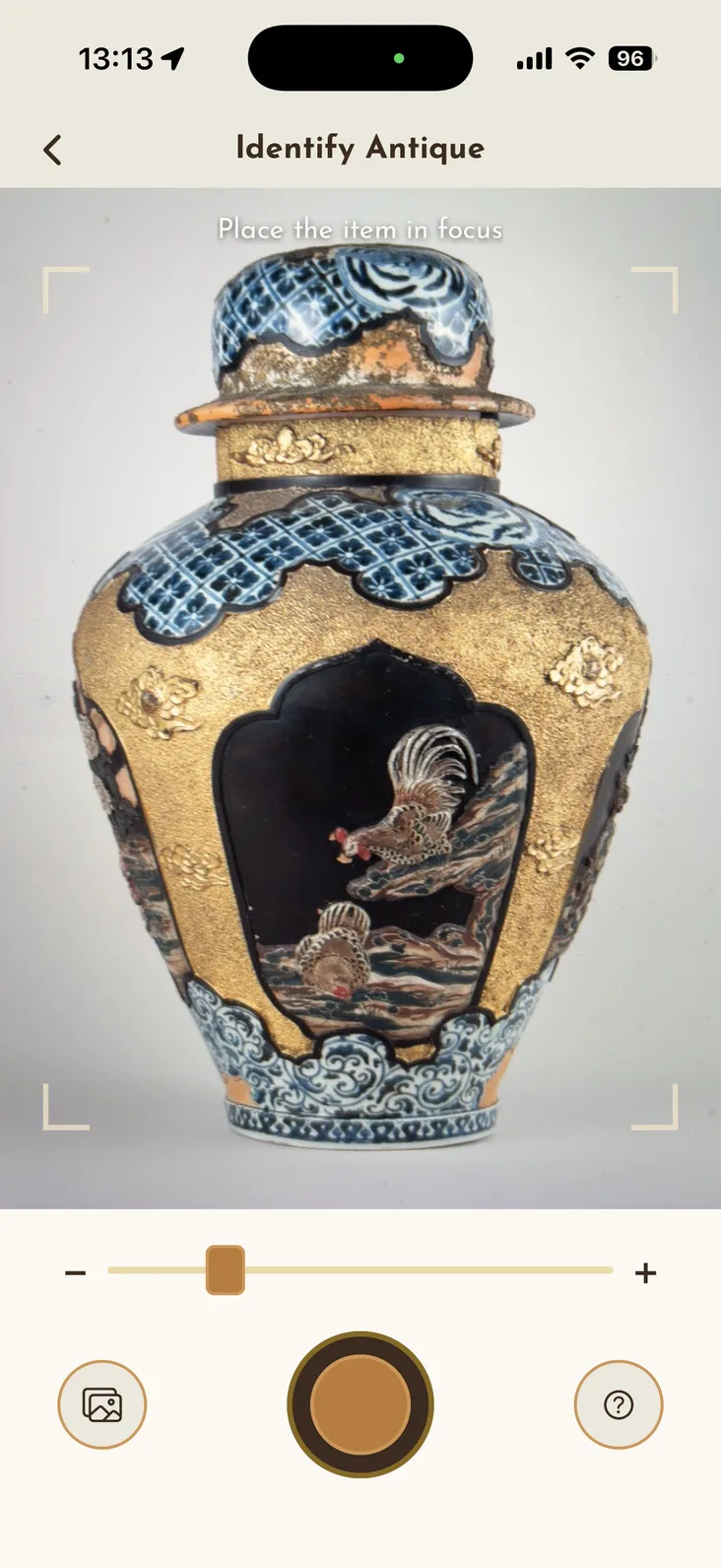
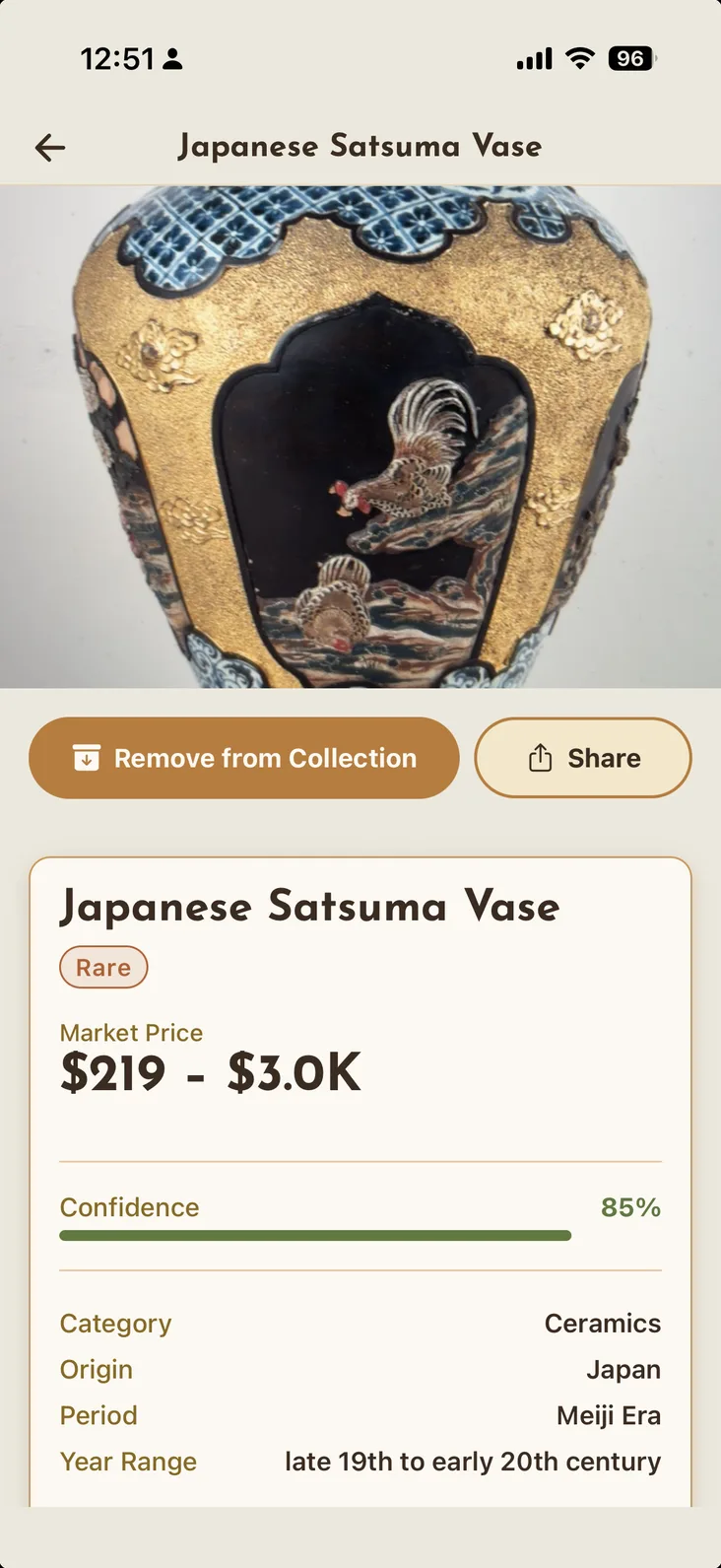
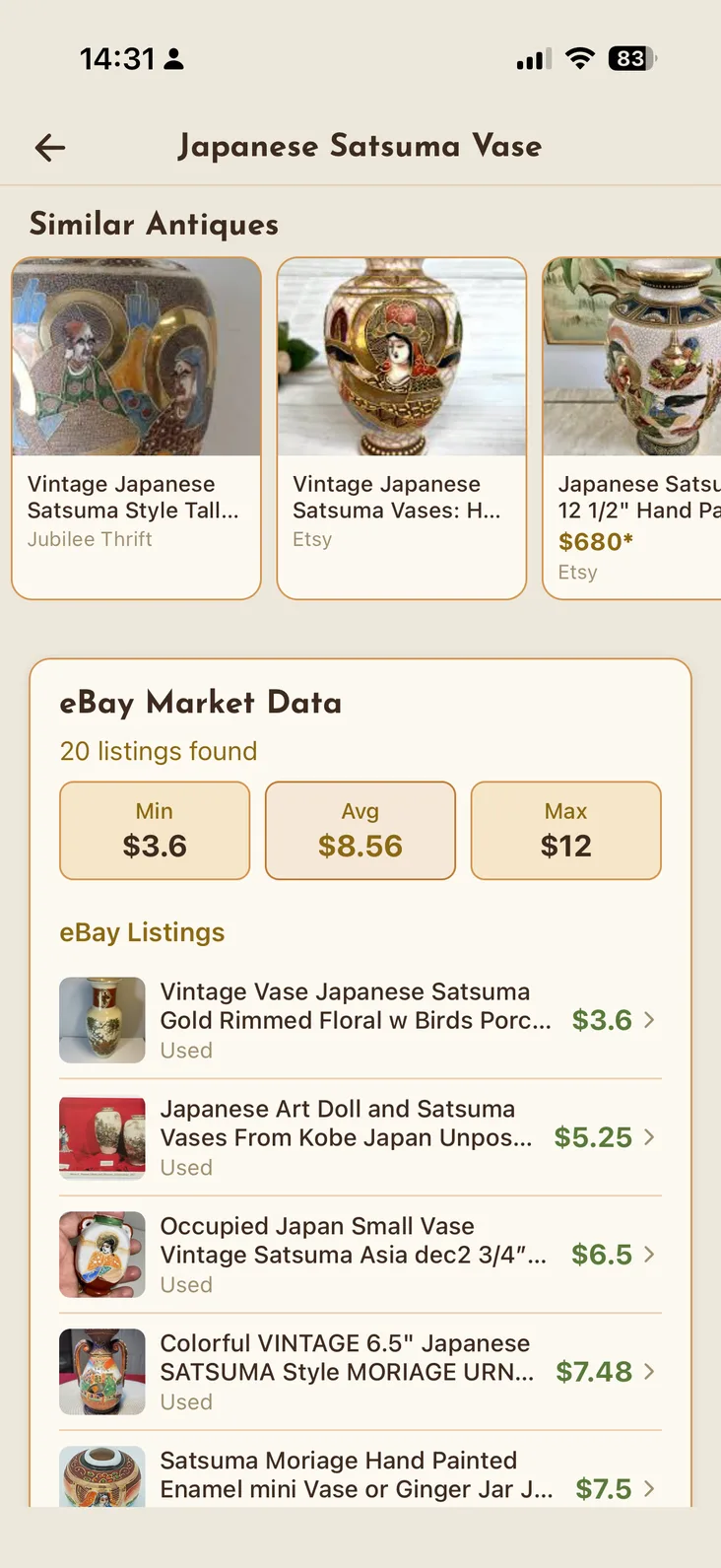
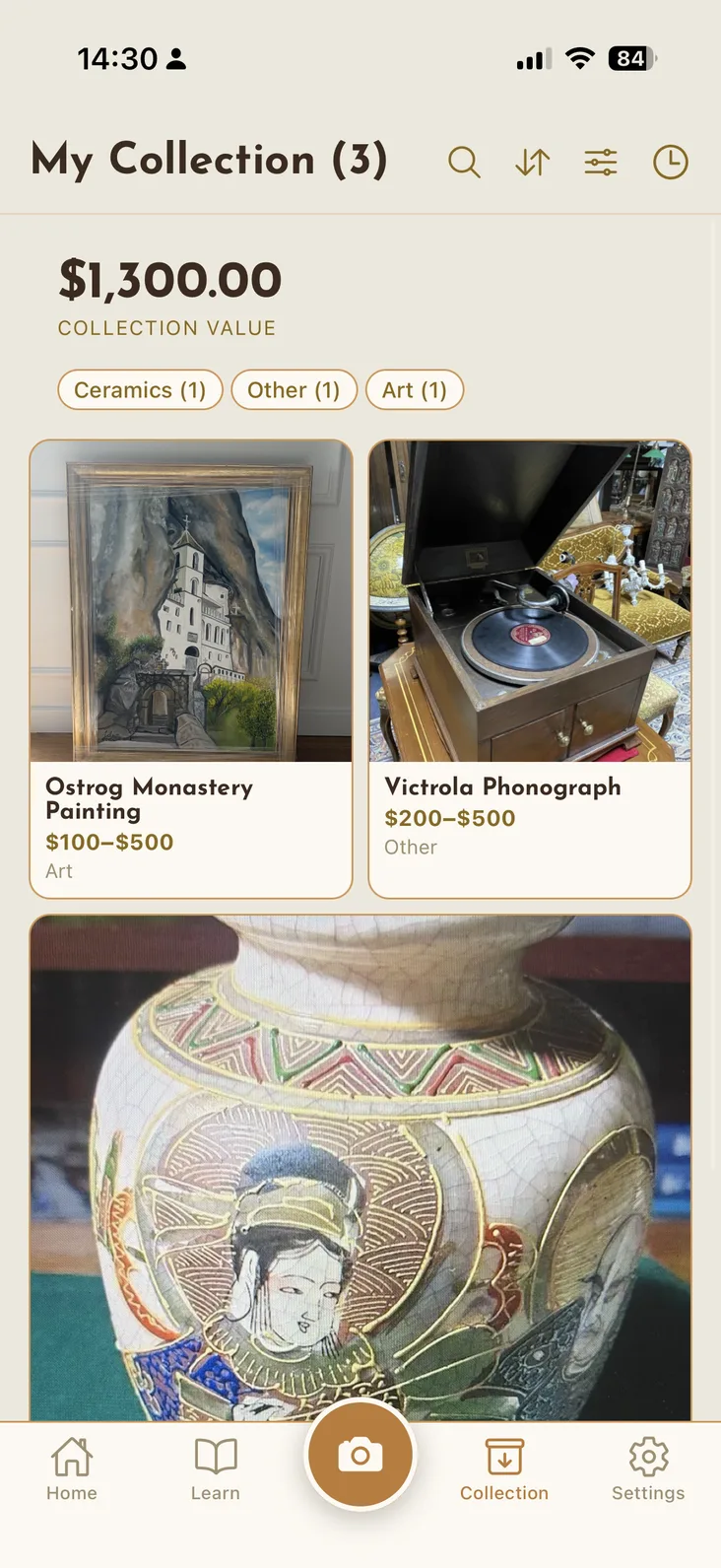
One honest note: Antique Snap returns AI-generated estimates, not certified appraisals. Value ranges reflect comparable live marketplace listings at the time of the search. For insurance, probate or a significant sale, take the report to a qualified appraiser — you'll walk in already knowing what the piece is.
How to choose an antique identification app
Whichever antique identification app you're considering — including this one — hold it against the five checks above:
- Does it read marks and details, or just shapes? An app that only pattern-matches silhouettes will call every blue-and-white plate "Ming style". Photograph a marked base and see whether the mark changes the answer.
- Where do its values come from? A static price database ages badly. Look for live comparables you can inspect yourself — if you can't see why it thinks $2,400–$3,800, be skeptical.
- Does it admit uncertainty? Any tool that's always 100% confident is hiding something. A confidence score that visibly drops on a bad photo is a feature, not a weakness. What ours measures, and where it falls short, is on our accuracy page.
- What does "free" actually include? Most identifier apps, Antique Snap included, are free to download with a subscription for full access (here it is billed by Apple, the price is shown in the App Store before you confirm, and you can cancel anytime). Distrust apps that hide pricing until after you've photographed your heirloom.
- What happens to your photos? Check the privacy policy. Antique Snap uses an anonymous, device-scoped account — no sign-up, no personal profile, and you can delete everything from Settings. Details in our Privacy Policy.
Want the manual craft in depth? Start with our five-step identification method, go deep on silver hallmarks, or browse the full guides library.
Frequently asked questions
Antique Snap is free to download and try — no account or sign-up needed to run your first identification. Full access is a subscription billed by Apple, with the price shown in the App Store before you confirm, cancellable anytime in Apple ID → Subscriptions. The full breakdown is in our free antique identification app guide.
Accurate enough to be useful, and honest about when it isn't. Every Antique Snap result carries a confidence score based on how much your photo actually shows — a clear shot of a marked base scores far higher than a blurry corner of a room. Below 50%, treat the result as a lead to research using the five manual checks — taught in full in our identification guide — not a final answer.
Eighteen categories: furniture, jewelry, ceramics, art, silver, glass, textiles, coins, watches, books, toys, cameras, militaria, clocks, instruments, stamps and prints — and thousands of forms within them. See how it works.
No — and no app does. Antique Snap returns AI-generated estimates built from live marketplace comparables; they carry no legal or insurance standing. For probate, insurance or a major sale, bring the report to a qualified appraiser as a head start. More in the FAQ.
Currently it's iPhone and iPad only (it also runs on Apple silicon Macs and Apple Vision Pro). Get it on the App Store.
The next thing you can't identify, you won't have to.
Free to try · No account needed · Cancel anytime
Download on theApp Store
On your computer? Scan with your iPhone camera to get the app.