How to Identify Antiques: The Five-Step Method
Updated August 9, 2026 · 10-minute read
Identifying an antique means answering four questions — what is it, who made it, when, and what is it worth today — and specialists answer them the same way every time: by running five checks. Marks. Construction and materials. Style and period. Wear and patina. The market. Run all five on any object, in that order, and you'll either identify it or know exactly what's still missing.
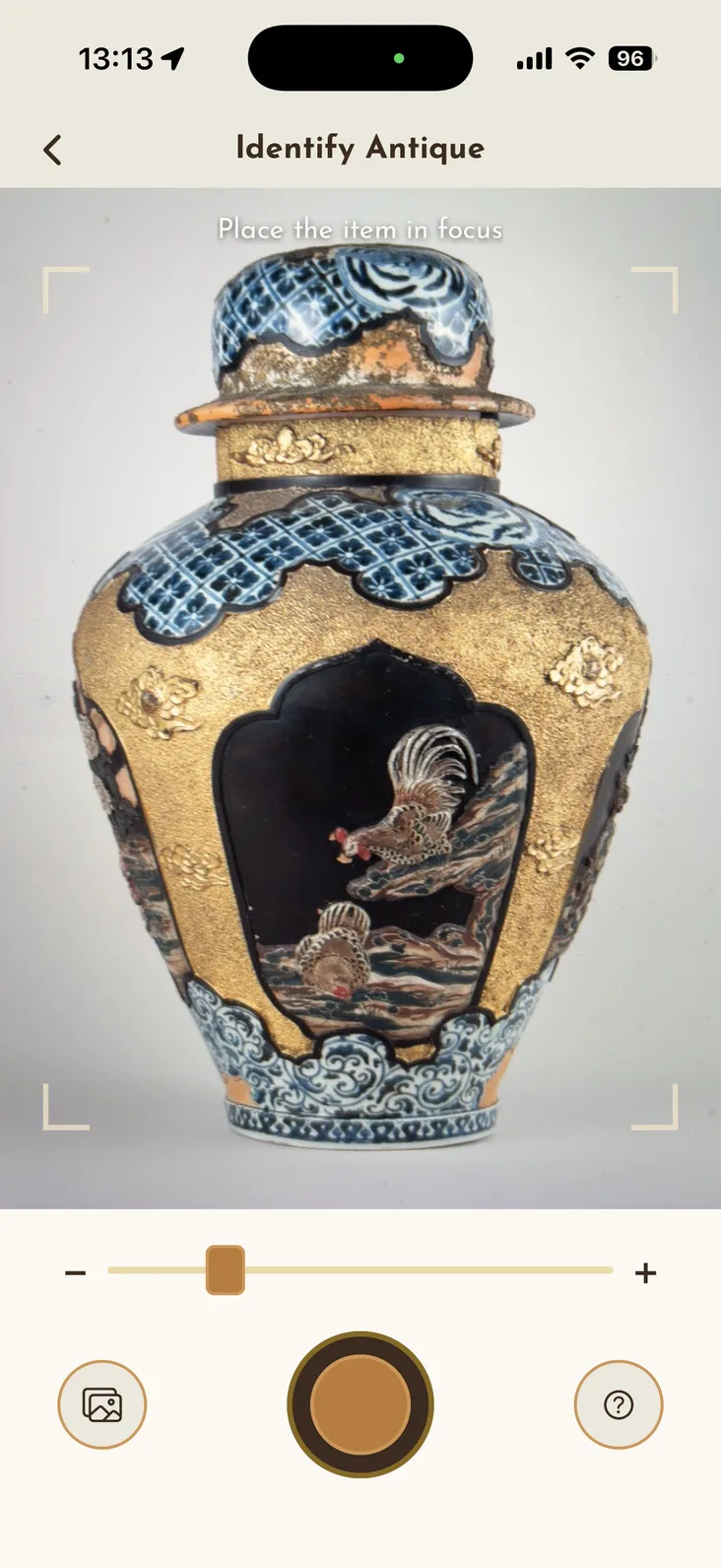
This guide teaches each check in enough depth to use on a real object this afternoon. And if you'd rather have the five checks run for you from a single photograph — that's what Antique Snap does, in about fifteen seconds.
Step 1 — Find and read the marks
Marks are the closest thing antiques have to a signature, and every category hides them somewhere predictable. Porcelain and pottery carry printed, painted or impressed backstamps on the underside of the base. Silver carries hallmarks — on the back of flatware handles, on the underside rim of teapots and bowls. Furniture hides paper labels and stamps inside drawers, on the back panel, or under the seat rail. Paintings are signed on the front, but the back — stretcher stamps, gallery labels, auction chalk — often says more. Clocks and watches are marked on the movement, not just the dial.
When you find a mark, photograph it before you research it — close up, in raking light from a low angle so worn stamps catch shadow. You'll need the photo whichever route you take: to compare against reference images, to show a dealer, or to hand to an identifier app.
And marks demand skepticism: a mark can hand you the maker, place and date in one stroke, but famous marks have been faked for as long as they've been famous, and a genuine mark on a damaged piece is still a damaged piece. Treat a mark as a hypothesis the other four checks then confirm. Silver's system is the deepest and most decodable of all — we cover it mark-by-mark in our guide to antique silver hallmarks.
Step 2 — Examine the construction and materials
Objects are honest about how they were made. Before roughly the 1860s, furniture joints were cut by hand: dovetails are slightly irregular, saw marks are straight, screws have off-centre slots and uneven threads. Machine production flipped each of those tells — perfectly even dovetails, circular saw arcs, uniform screws. Wood shrinks across the grain over a century, so a genuinely old round tabletop measures slightly oval.
Materials date things just as firmly. Old mirror glass waves, and its silvering spots and greys. Early glass carries a rough pontil scar underneath; moulded seams mean machine production. Bakelite and celluloid behave differently from modern resins in weight and feel. Hand-forged nails, wooden pegs, hide glue, horsehair stuffing — each has a "not before" and "not after" date attached to it.
A few hard "not before" dates worth keeping in your pocket: Phillips-head screws mean the 1930s or later; staples in upholstery, the twentieth century; plywood backing panels, roughly the 1900s onward; particle board, the 1950s onward. Any one of these on a piece styled to look Georgian ends the conversation. Construction evidence is the hardest thing to fake, which makes it the strongest single check on this list.
Step 3 — Place the style and period
Every era leaves a recognisable silhouette. Georgian design is restrained and symmetrical; Victorian is ornamented and dark; Art Nouveau moves in whiplash plant curves; Art Deco is geometric and stepped; Mid-Century Modern is teak, taper and clean line. Learn a dozen silhouettes and you can place most objects within a few decades on sight.
The date ranges worth memorising, roughly: Georgian 1714–1837, Victorian 1837–1901, Edwardian 1901–1910, Art Nouveau 1890–1910, Art Deco 1920–1939, Mid-Century Modern 1945–1969. Regional vocabularies overlap these — American Federal, French Empire, Biedermeier — but the big six cover most of what turns up in attics and flea markets, and naming the period correctly is half the search vocabulary you'll need in step 5.
The trap is that style is exactly what reproductions copy. A "Victorian" balloon-back chair made in 1985 has perfect Victorian lines — and staples in the upholstery. So treat style as a claim the object is making, then let construction (step 2) and wear (step 4) vote on whether the claim is true. When style and construction disagree, construction wins.
Step 4 — Read the wear and patina
A century of use leaves wear precisely where use happens: handles polished smooth by hands, chair stretchers scuffed by shoes, drawer runners grooved by a thousand openings, brass darkened in crevices and brightened on high points. Patina — the soft surface depth wood and metal acquire over decades — is slow chemistry, and it's very hard to counterfeit convincingly.
What fakers produce instead is uniform aging: the same darkness in wear zones and sheltered corners alike, scratches distributed like rainfall rather than concentrated at contact points. Even wear is a red flag; honest wear is asymmetric. Check the hidden surfaces too: unfinished wood oxidises to deep amber over decades, so raw, pale timber inside the drawer of an allegedly Victorian chest means recent work. New surfaces in old places are the loudest tell there is. Condition also moves value far more than beginners expect — a hairline crack can halve a ceramic's price while untouched original finish can double furniture's — which is why wear reading feeds directly into what your antique is worth.
Step 5 — Check the market
Identification without a number is half an answer. What a piece is worth is what comparable pieces are actually fetching — current listings and recent sold prices for the same form, period and condition, not what a price book printed years ago hoped. eBay's sold-listings filter and auction archives are the raw sources, and our valuation guide covers how to read them — including the three different "worth" numbers (auction, retail, insurance) that trip up most first-time sellers.
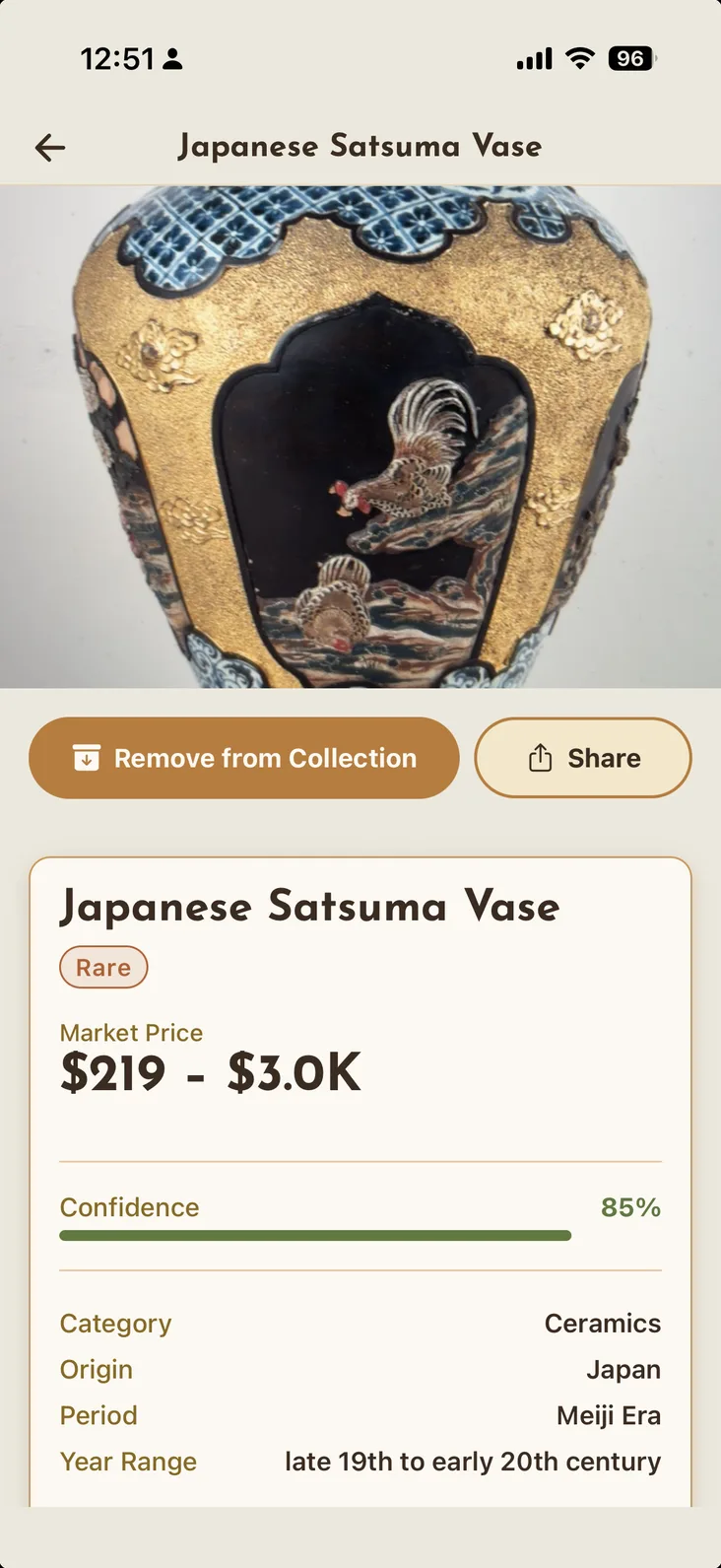
Here the beginner hits a circular problem: you can't search for comparables until you know the piece's proper name, and the proper name is what you were trying to find out. "Old blue vase" returns noise; "Japanese Satsuma vase, Meiji" returns a market. The first four checks earn you the vocabulary; step 5 spends it.
The method works. The hours are the problem.
Run all five checks by hand and you'll spend an evening per object — cross-referencing mark databases, comparing joinery photographs, scrolling sold listings — and that's when the trail is good. For one mystery object that's a satisfying puzzle; for the forty boxes of an estate clearance it's a month of evenings. A professional appraisal outsources the work for $50–$200 per item. The method in this guide is genuinely how it's done; nothing about it is secret. It's just slow.
Antique Snap runs the same five checks — marks, construction, materials, style, wear and live market comparables — from one photograph, in about fifteen seconds. The photo is the evidence either way; the difference is who does the reading.
Five checks. One photo. Fifteen seconds.
Identified, dated, placed — and priced against live marketplace listings. Free to try, no account needed.
Download on theApp StoreHow Antique Snap runs the five checks for you
- Photograph the piece — the whole object first, then the base, mark or signature if there is one. Good light matters more than a good camera.
- The AI reads the evidence — form, glaze, joinery, wear patterns and visible marks, checked across eighteen categories and thousands of documented forms.
- You get the full report — name, origin, period, materials, a rarity class, an estimated value range built from live Etsy, eBay and auction listings, and a confidence score that tells you honestly how much the photo showed. Anything under 50% is a research lead, not a verdict.
Identify antiques by category
The five checks apply everywhere, but each category has its own marks, materials and tells. Start with the guides that are live now:
- Silver hallmarks — reading the lion passant, assay-office marks, date letters and maker's marks, and telling sterling from silverplate.
- What's it worth — sold comps, condition, rarity and the three price bands every owner should know.
- Identifier apps — what a good antique identifier app has to do, and how to judge any of them.
- Free identification — what "free" genuinely gets you, app or no app.
Guides to furniture, pottery and porcelain marks, and jewelry are in progress — the full method above works on all three in the meantime.
Frequently asked questions
Photograph it with an identifier app. Antique Snap returns the name, origin, period and an estimated value range in about fifteen seconds from one photo. The manual route above gives the same answer and typically takes an evening per object.
Yes, if the photo shows the evidence: the whole object plus a close-up of any mark, signature or construction detail. AI identifier apps read form, glaze, joinery, wear and marks from the image — the same evidence a specialist works from in person. See how it works.
The customary rule is 100 years or older. Pieces roughly 20 to 99 years old are "vintage", and "retro" usually means newer items made in an older style. The labels matter for customs and dealer descriptions, but age alone doesn't set value — rarity, demand and condition do, as our valuation guide explains.
Look for evidence that disagrees with itself: period style with modern construction (Phillips screws, staples, perfectly even machine dovetails), uniform artificial "aging" instead of wear concentrated where hands and feet actually go, and marks that look molded or soft rather than crisply struck — a tell covered in depth in the hallmarks guide.
Check what comparable pieces actually sold for — eBay's sold-listings filter and auction records — rather than asking prices. Condition and rarity move the number substantially. Our guide to finding your antique's value walks through it, and Antique Snap does the comp lookup for you.
The next thing you can't identify, you won't have to.
Free to try · No account needed · Cancel anytime
Download on theApp Store
On your computer? Scan with your iPhone camera to get the app.