Antique Pottery Marks Identification for Beginners
Updated October 1, 2026 · 8-minute read
Antique pottery marks identification starts with turning the piece over. Most makers put their mark on the underside: a printed stamp, a painted symbol, or a name pressed into the clay. Read what the mark says, notice how it was applied, and look for small words like "England", "Ltd" or "Made in". Those details usually narrow the date to a few decades before you look anything up.
This guide covers where marks hide, the different kinds, the clues that date them, and how to spot a mark that has been faked. If you want a quick first answer, photograph the base with Antique Snap, then use this page to check it.
Where to find the mark
On vases, jugs, bowls and figurines, look on the underside of the base, including inside the raised ring the piece stands on (the foot ring). On plates and saucers, check the back, near the center. On cups, look under the foot. Figures are sometimes marked on the back of the base rather than underneath. Marks can be small, faint or partly covered by glaze, so use good light and tilt the piece. A phone torch held low at an angle makes pressed marks much easier to see.
Lids were often marked too, or given a number that matches the base. If the numbers don't match, the lid may have come from a different piece.
The five main kinds of mark
How a mark was made tells you something before you even read it.
- Impressed marks are pressed into the soft clay before firing, like a stamp in wax. They can't be added later without damaging the piece, which makes them reliable. Wedgwood, for example, used impressed name marks for a very long time.
- Incised marks are scratched into the clay by hand, often by studio potters, and can include initials or a date.
- Painted marks are drawn with a brush, often in blue under the glaze. Many Chinese reign marks and the Meissen crossed swords were painted this way.
- Printed marks, also called backstamps, are transferred onto the piece. They often include a maker's name, a pattern name, a symbol such as a crown or a globe, and sometimes a country.
- Paper labels and stickers are mostly modern and come off easily, so on their own they prove very little.
It also helps to know whether a mark sits under the glaze or on top of it. Run a fingernail over it. A mark under the glaze is sealed in and feels perfectly smooth. A mark on top of the glaze can sometimes be felt, and because it could have been added after the piece was made, it deserves a closer look. Plenty of genuine marks are on top of the glaze, especially gold ones, so this is a reason to check, not proof of a fake.
Small words that date a piece
You often don't need the maker to get a rough date. Some words only started appearing on marks after a certain year.
- A country name, such as "England" or "Germany". From 1891, the McKinley Tariff required goods imported into the United States to show their country of origin. A country name on a mark usually means 1891 or later.
- "Made in England" and similar. The fuller wording is generally later again, most often from the early 20th century onward.
- "Ltd" or "Limited" in a British pottery's name came after limited companies were allowed in 1855, and is far more common from the 1880s on.
- "Trade Mark" on British marks generally appears after the Trade Marks Registration Act of 1875.
- A diamond-shaped registration mark on British wares was used from 1842 to 1883. From 1884 it was replaced by "Rd No" followed by a number, and the number can be looked up to find the year.
- "Nippon" means Japan and was used on exports to the US from 1891 to 1921. After that the mark had to say "Japan" or "Made in Japan". "Made in Occupied Japan" dates a piece to between 1945 and 1952.
- "West Germany" was used from 1949 to 1990.
- "Bone china" in a backstamp is mostly 20th century.
- "Dishwasher safe", "microwave safe" or "oven to table" tell you the piece is modern, whatever the rest of the mark says.
Pottery or porcelain?
Before you read the mark, it helps to know what you're holding. Hold the piece up to a strong light. Porcelain usually lets some light through where it is thin, feels cool and smooth, and gives a clear ring when tapped gently. Earthenware is opaque, often lighter in weight, and where it is chipped or unglazed you can see a softer, more porous body. Stoneware sits between the two: heavy, dense and opaque. Knowing which one you have rules out a lot of makers straight away.
Famous marks, and why they get copied
The most valuable marks are the most copied. The Meissen crossed swords may be the most imitated mark in European porcelain, and many factories used similar crossed lines on their own wares. Sèvres pieces carry two interlaced letter Ls, also widely copied. Chinese reign marks, usually four or six characters naming an emperor, were often put on later pieces as a mark of respect for an earlier period, so a reign mark tells you what a piece honors, not always when it was made. On Japanese Satsuma ware, a cross inside a circle is common on later export pieces as well as earlier ones.
This is why a mark should always agree with the rest of the piece: the shape, the clay, the glaze, the painting and the wear. If the mark says 18th century and everything else says 1950, believe everything else. The same idea applies to silver hallmarks and to the stamps on antique jewelry, where valuable marks are also the most often faked.
How to spot a fake or added mark
- The mark looks newer than the piece. A crisp, bright mark on a base that is otherwise worn and dirty is suspicious.
- The mark sits on top of the glaze where that maker normally marked under it.
- Spelling or proportions are off. Compare it with a known genuine example. Copies often get small details wrong.
- The base shows no wear. A piece that has stood on shelves for a century has fine scratches and some grey dirt on the unglazed foot ring. A clean, untouched foot on an "antique" is worth questioning.
- The mark has been ground away. Sometimes a modern mark or a "Made in" line is removed to make a piece look older. A rough, dull patch on the base where a mark should be is a warning sign.
What if there is no mark?
Lots of genuine antique pottery has no mark at all. Early English pottery, much country pottery and many pieces from sets were never marked, and some marks simply wore away. Unmarked pieces are identified the same way as everything else: shape, body, glaze, decoration and wear. Furniture works the same way, since it is rarely marked at all, as our furniture guide shows. Our five-step identification guide explains how.
Mark books are thick, and you need to know where to look
Specialists use reference books such as Godden's encyclopedia of British pottery and porcelain marks and Kovels' dictionary of marks. They are excellent, but they hold thousands of marks, many of them nearly identical, and they only help once you know roughly which country and period to search. Matching a worn, half-visible symbol can take an evening.
Antique Snap reads the mark from a photo together with the shape, glaze and decoration, so a doubtful mark gets checked against the rest of the piece. It returns the maker, origin, period and an estimated value range in about fifteen seconds.
Photograph the base. Skip the mark books.
Antique Snap reads the mark together with the shape, glaze and decoration, and returns the maker, period and an estimated value range. Free to try, no account needed.
Download on theApp StoreHow to identify a pottery mark with one photo
- Photograph the whole piece from the side in good light.
- Turn it over and photograph the mark close up. Hold your phone steady and let it focus. A low light from one side helps with pressed marks.
- Read the report. You get the name, maker, origin, period, a rarity class and an estimated value range with a confidence score. A clear photo of a marked base usually scores much higher than a side view alone.
- Compare the similar pieces from Etsy, eBay and auction houses, and check the marks on them against yours.
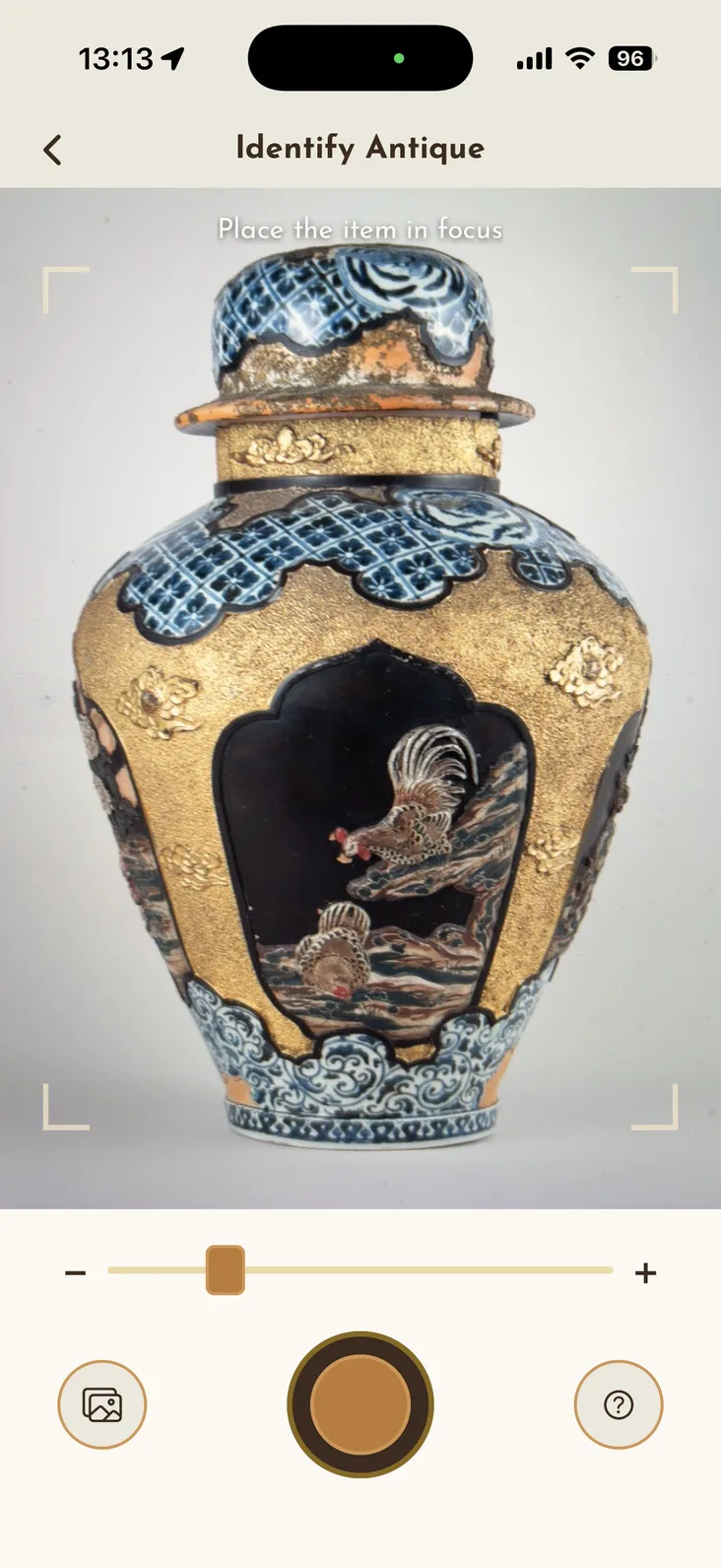
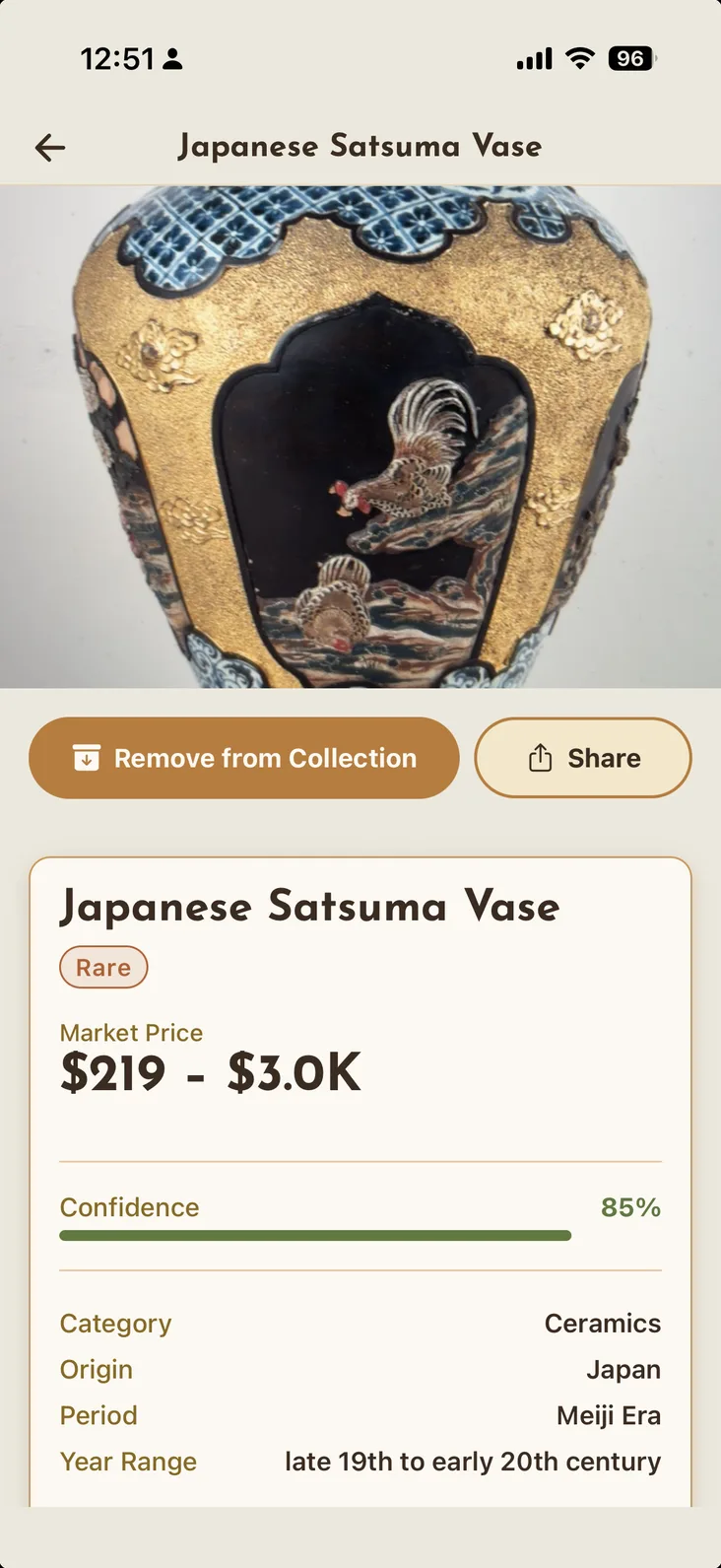
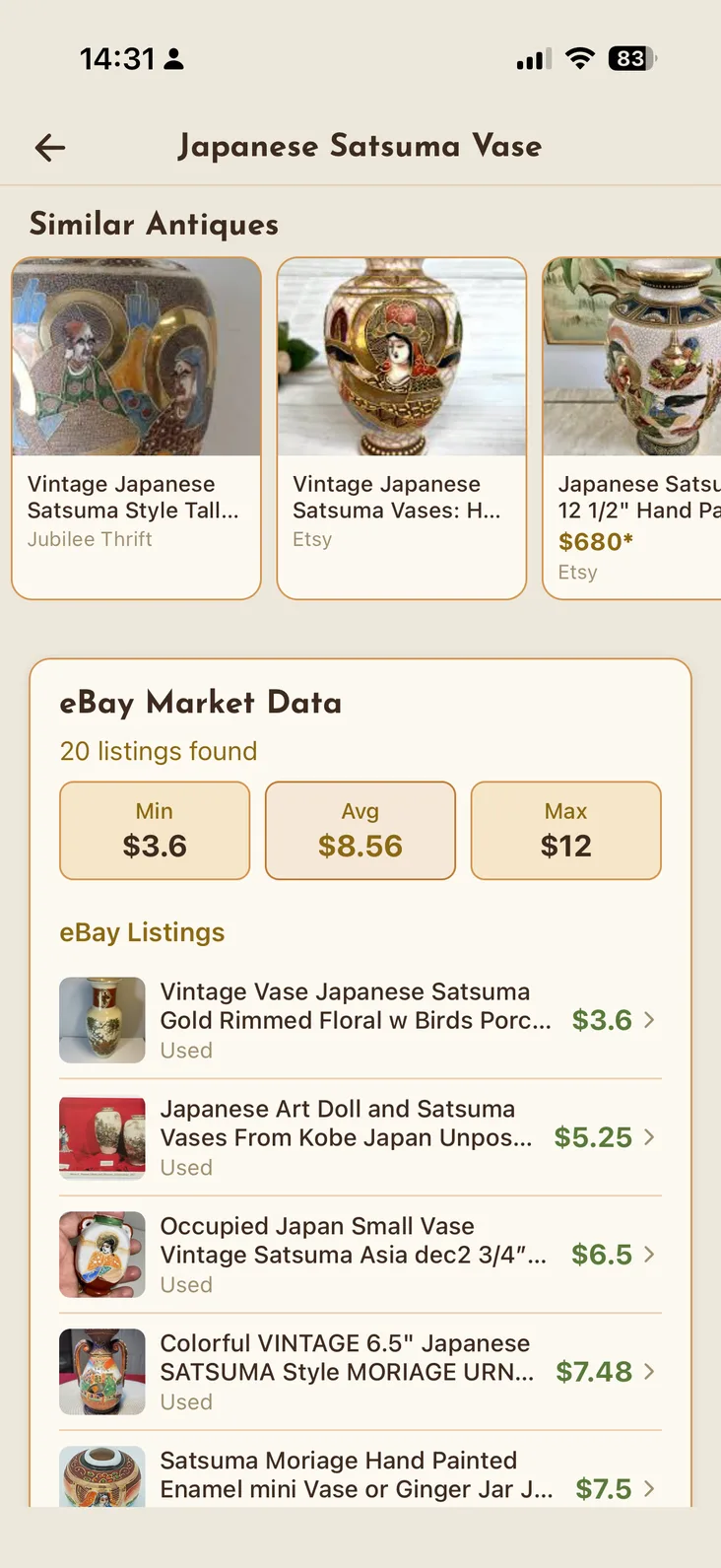
Values in the app are AI-generated estimates, not certified appraisals, based on similar items listed for sale at the time of the search. For insurance, probate or a sale, consult a qualified appraiser.
Frequently asked questions
Turn the piece over, photograph the mark in good light and note how it was made: pressed in, scratched, painted or printed. Read any words, especially a country name, "Ltd" or "Made in", which help date it. Then compare it with mark references or let an app check it against the whole piece. Our identifier app guide explains what a good app should check.
Not always, but it usually means it is newer than it looks. A country name on its own generally dates a piece to 1891 or later, and "Made in" wording is mostly 20th century. A piece from the 1910s can still be over 100 years old. Use the mark together with the shape, glaze and wear, as in our five-step method.
Porcelain is fired at a higher temperature, so it is hard, smooth and usually lets some light through where it is thin. Earthenware pottery is fired lower, stays opaque and has a softer, more porous body you can see at chips. Stoneware is dense and heavy but opaque. Knowing which you have narrows down possible makers. See our other guides for more categories.
It can be. A lot of early and country pottery was never marked, and marks often wear away. Value depends on what the piece is, its age, quality and condition, not on the mark alone. A chip or hairline crack usually lowers the price more than a missing mark. Our guide to what your antique is worth explains how to price it.
Yes. Antique Snap reads the mark from a photo and checks it against the shape, glaze and decoration of the piece, then gives the maker, period and an estimated value range with a confidence score. A sharp close-up of the base gives the best result. Read how app values work before relying on the number.
Turn it over, take a photo, find out.
Free to try · No account needed · Cancel anytime
Download on theApp Store
On your computer? Scan with your iPhone camera to get the app.