How to Identify Antique Jewelry
Updated October 1, 2026 · 8-minute read
To identify antique jewelry, look at the back before the front. Check the metal stamps, the clasp or fastening, and how the stones are set. Then look at the style, which often points to a period. A cheap magnifying glass or a jeweler's loupe (10x is ideal) shows most of what you need. Fastenings in particular changed over time, so a clasp can rule a piece in or out of an era in a few seconds.
This guide goes through each check in order, in plain terms. If you would like a starting point first, photograph the piece with Antique Snap and use this page to check what it tells you.
A quick word on terms. "Antique" jewelry is usually at least 100 years old. "Vintage" means roughly 20 to 99 years. "Estate" jewelry just means it was owned before, and can be any age.
Read the metal stamps
Look on the inside of rings, near the clasp of necklaces and bracelets, on the pin or back of brooches, and on earring posts. Stamps are tiny and often worn, so use magnification and good light.
- Gold is marked in karats, such as 9K or 9ct, 10K, 14K, 18K and 22K, or in parts per thousand: 375, 417, 585, 750 and 916.
- Gold-colored but not solid gold pieces may say GF (gold filled), RGP (rolled gold plate), GP (gold plated) or HGE (heavy gold electroplate). These have a thin layer of gold over another metal.
- Silver may be marked Sterling, 925, or 800 and 835 on many continental European pieces. British silver jewelry may carry full hallmarks, which our silver hallmarks guide explains how to read.
- Platinum is marked PLAT, PT or a number such as PT950. Platinum was popular for fine jewelry from around 1900 to the 1940s, so it fits Edwardian and Art Deco pieces well.
Don't panic if there is no stamp. A lot of jewelry made before the early 1900s was never marked, especially outside Britain. Missing marks mean you need to look harder at the other clues, not that the piece is fake.
Date it by the clasp and fittings
Fastenings were improved over time, and later designs rarely appear on genuinely early pieces. They are one of the most reliable dating clues you have. Just remember that clasps can be replaced during repairs.
- C-clasp on a brooch: a simple hook shaped like the letter C, with the pin often sticking out past the edge. Typical of the 19th century and early 1900s.
- Trombone clasp: a small tube that slides in and out to lock the pin. Used from the late 1800s into the early 20th century.
- Rotating safety catch: the small lever that turns to lock a brooch pin. Common from the 1910s onward.
- Screw-back earrings appear around 1900. Clip-on earrings date from the 1930s onward.
- Spring ring clasps, the round ones with a small pull, have been used since around 1900. Lobster clasps are mostly a later 20th-century design. A lobster clasp on a "Victorian" necklace is either a replacement or a sign the piece is newer.
Look at the stones and how they are set
Diamond cutting changed a lot, and older cuts look different under a loupe.
- Rose cut: a flat back with a dome of triangular facets on top. Common in Georgian and Victorian pieces.
- Old mine cut: a cushion shape, almost square with rounded corners, with a tall top and a small flat facet at the bottom (the culet) that you can see through the top as a little dot. Typical before the 1890s.
- Old European cut: round, but with that same visible dot at the bottom and chunkier facets. Common from about the 1890s to the 1930s.
- Modern brilliant cut: round and very sparkly, with no visible dot. Mostly from the 1930s and 1940s on.
Settings help too. Georgian jewelry, before 1837, often has closed backs with foil behind the stones to boost their color. Later settings are usually open at the back to let light through. Very old pieces may also use paste, a high-quality cut glass. Paste was used on purpose and is collectible in its own right, so it isn't a fake.
To tell glass from a real gemstone, look with a loupe for small round air bubbles, which point to glass, and for facet edges that look rounded or soft rather than sharp. Glass also scratches and chips more easily, so worn facet edges on an old piece can be a clue. For a certain answer on a valuable stone, ask a gemologist; the GIA has good background on how gems are tested.
Know the main jewelry eras
- Georgian, 1714 to 1837: handmade, often closed-back settings, rose and old mine cut diamonds, paste. Genuine Georgian jewelry is scarce.
- Victorian, 1837 to 1901: lockets, cameos, mourning jewelry in black jet, pieces made with woven hair, and lots of gold with sentimental motifs like hearts, hands and snakes.
- Art Nouveau, about 1890 to 1910: flowing lines, enamel, insects, flowers and women's faces.
- Edwardian, 1901 to about 1915: light, lacy designs in platinum and diamonds, with tiny beaded edges called milgrain.
- Art Deco, 1920s and 1930s: bold geometric shapes, platinum, contrasting colors and small stones cut to fit tightly in rows.
- Retro, 1940s: big, chunky shapes in rose and yellow gold. This is vintage rather than antique today.
Handmade or mass-produced?
Look closely at the back and the edges. Handmade pieces show small irregularities: slightly different prongs, hand-cut openwork, engraving with tiny wobbles. Modern cast copies tend to look too even, and the metal can have tiny pits from the casting process. Very sharp, perfect detail on a piece sold as 150 years old is a reason to ask more questions.
Is it real gold?
Start with the stamp. Then look at the places that get the most wear, such as the edges of a ring band or the back of a clasp. If a different color metal is showing through, the piece is plated, not solid. A magnet can help a little: gold isn't magnetic, so a piece that sticks strongly is not solid gold. A piece that doesn't stick isn't proven to be gold, though. For a sure answer, a jeweler can test it in a few minutes.
Spotting reproductions
"Victorian style" and "Art Deco style" jewelry is made in large numbers today. Signs that a piece is newer than it looks include a lobster clasp, bright metal with no wear on the back, stamps that use modern wording, stones that are too perfect for the period, and very regular casting. Costume jewelry is a separate world: signed pieces from makers such as Trifari, Miriam Haskell or Eisenberg are collected, and patent numbers stamped on the back can help date them.
A lot of small details to check
Done properly, these checks need a loupe, good light, a feel for dozens of clasp types and stone cuts, and a fair amount of searching. For a single ring it's a nice puzzle. For a full jewelry box it can take days. The same method works on any antique, and our five-step identification guide explains it for every category, and we have separate guides for furniture and pottery and porcelain marks.
Antique Snap runs the same checks from a photo. It looks at the style, metal, stones and setting, names the piece and its likely period, and shows an estimated value range from similar pieces for sale right now, in about fifteen seconds.
Not sure if it's old, gold or glass?
Photograph the piece and its back. Antique Snap names the style and period and shows an estimated value range from similar pieces for sale. Free to try, no account needed.
Download on theApp StoreHow to identify jewelry with one photo
- Photograph the front on a plain background in daylight. Avoid flash, which bounces off stones.
- Photograph the back and the clasp as well. Stamps and fastenings are where the dating clues are.
- Read the report. You get the name, period, materials, a rarity class and an estimated value range with a confidence score. If the score is low, try a sharper close-up.
- Compare the similar pieces from Etsy, eBay and auction houses, and save it to My Collection so the whole jewelry box adds up to one running total.
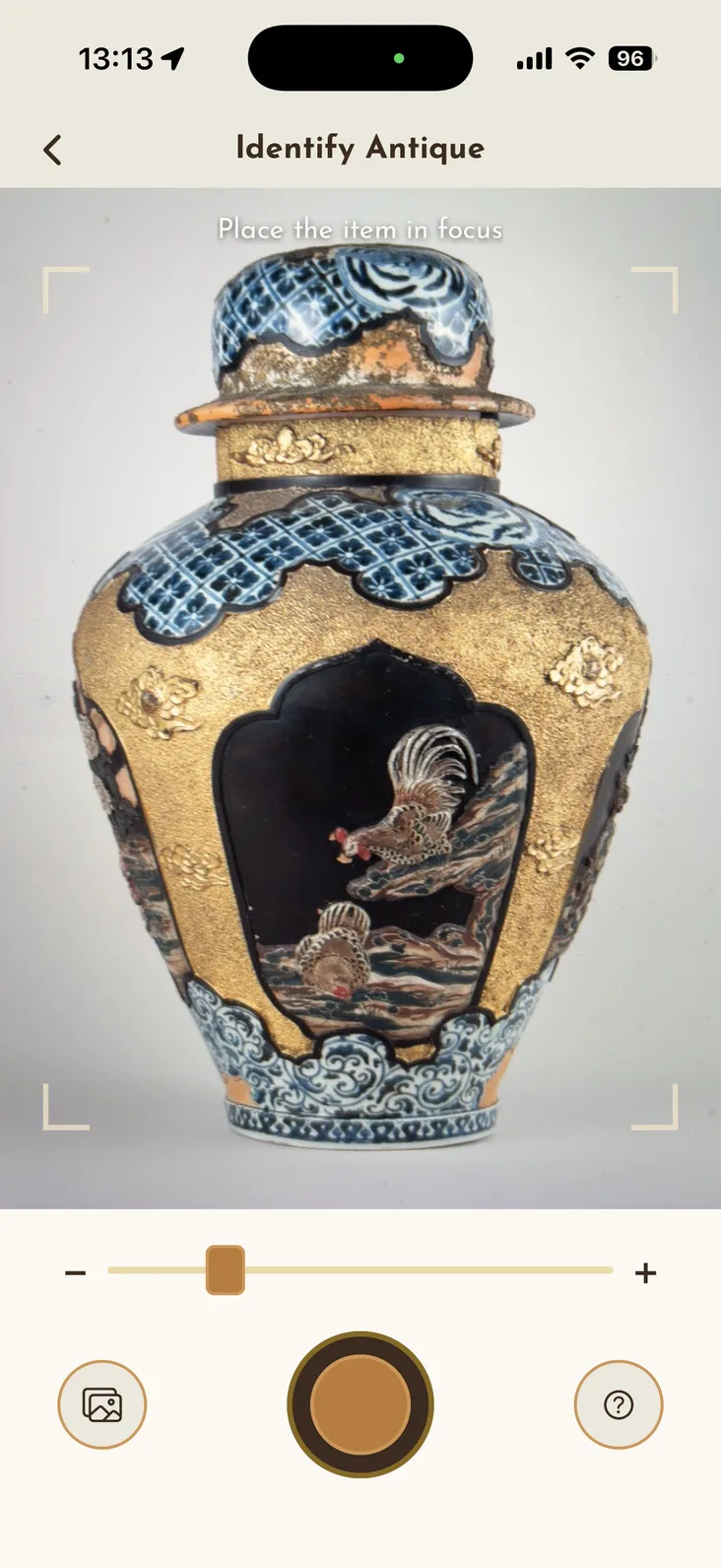
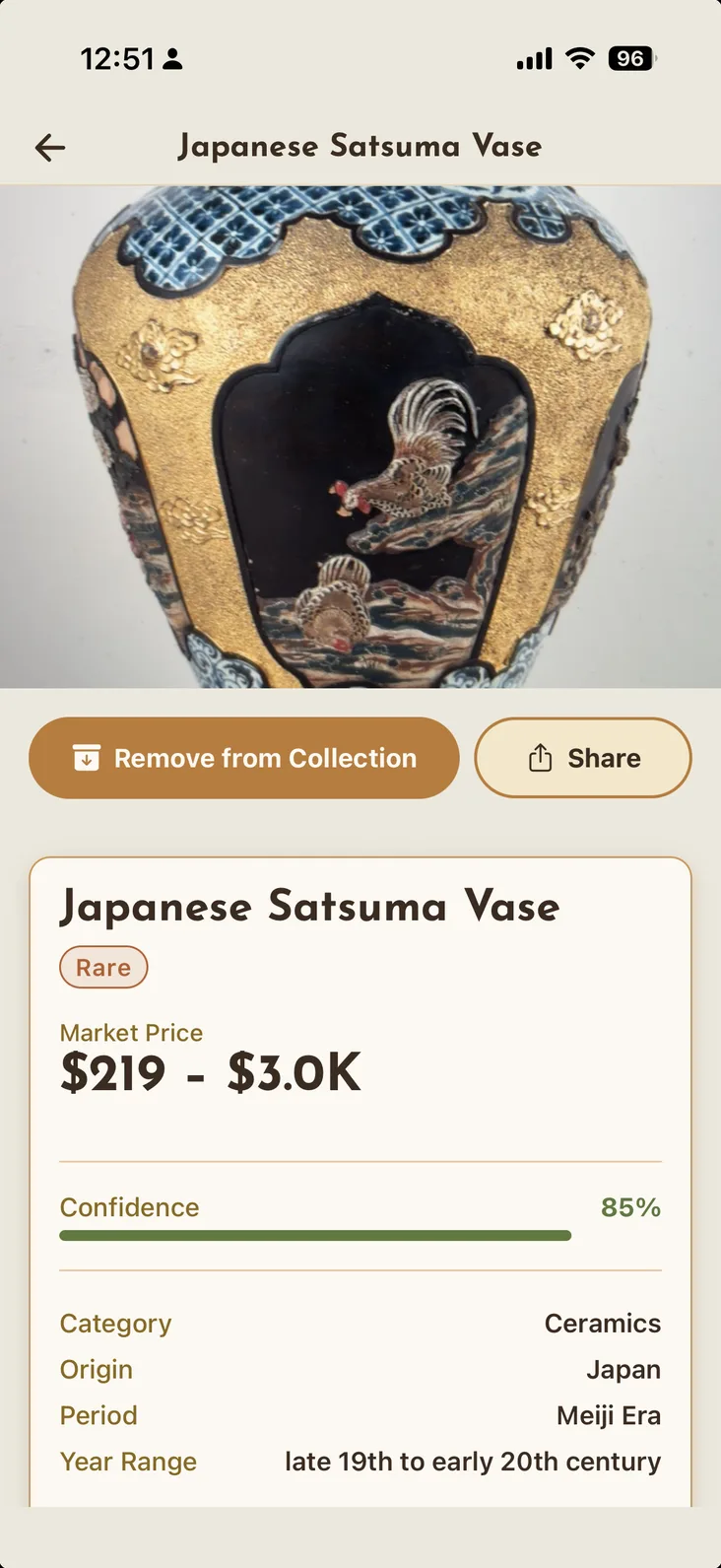
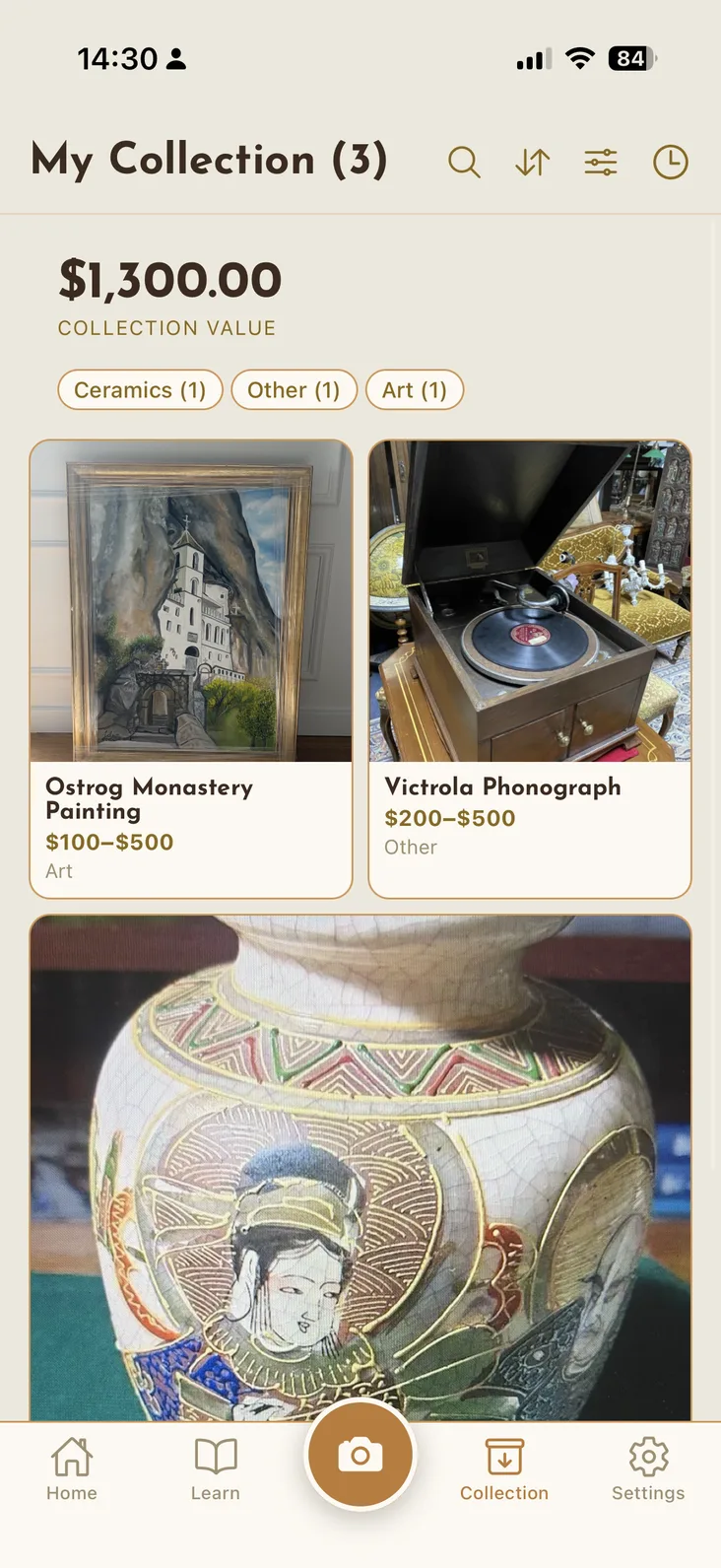
Values in the app are AI-generated estimates, not certified appraisals, based on similar items listed for sale at the time of the search. For insurance, probate or a sale, consult a qualified appraiser. Our guide to antique value apps explains how to read the range.
Frequently asked questions
Check the age clues together: metal stamps, the type of clasp, how the stones are cut and set, and the style. A C-clasp brooch with rose cut stones points to the 19th century, while a lobster clasp or clip-on earrings point to the 20th. Antique usually means over 100 years old, vintage 20 to 99. Our five-step method uses the same approach for all antiques.
Look for a karat stamp such as 14K or 585, and check worn edges for a different metal showing through, which means plating. GF, RGP and GP stamps mean gold filled or plated. A strong pull from a magnet rules out solid gold. Many older pieces have no stamp, so a jeweler's test is the only sure answer. Silver marks are covered in our hallmarks guide.
C-clasps on brooches are mostly 19th century to early 1900s. Trombone clasps run from the late 1800s into the early 20th century, and rotating safety catches are common from the 1910s. Screw-back earrings appear around 1900 and clip-ons in the 1930s. Lobster clasps are mostly later 20th century. Clasps get replaced, so check other clues too. More categories are in our guides library.
Some of it is. Signed pieces by well-known makers such as Trifari, Miriam Haskell and Eisenberg are collected, and good Georgian or Victorian paste can be valuable. Unsigned, mass-made pieces usually sell for small amounts. Condition matters a lot: missing stones and worn plating lower the price. Our guide to what your antique is worth explains how to check real sale prices.
An app can give you a strong starting point. Antique Snap names the piece, its likely period and materials and shows an estimated value range with a confidence score. Clear photos of the front, the back and the clasp work best. It can't test metal or confirm a gemstone, so for valuable pieces a jeweler should check. Read how app values work.
Find out what's in the jewelry box.
Free to try · No account needed · Cancel anytime
Download on theApp Store
On your computer? Scan with your iPhone camera to get the app.