Japanese Pottery Marks and How to Date Them
Updated October 26, 2026 · 10-minute read
Japanese pottery marks are easiest to date by their wording. "Nippon" on the base usually means the piece was made for the US market between 1891 and 1921. "Japan" or "Made in Japan" means 1921 or later, and "Made in Occupied Japan" points to 1947 to 1952. A maker's mark, such as Noritake's M in a wreath or the cross in a circle on Satsuma, can narrow it down further.
That gets most pieces into the right 20 or 30 years. The rest of this guide covers:
- The wording and the years it points to.
- Where the mark is and how it was applied.
- Five characters worth knowing.
- Maker marks: Noritake and Satsuma.
- Fake Nippon marks.
- What it's worth.
Holding the piece right now? Photograph it with Antique Snap for a first answer, then use this page to check what it tells you.
Date it by the wording first
The English words on the base are the quickest clue. US import rules decided which words Japanese makers had to use, and those rules changed at known dates.
| Mark says | Usual date | Keep in mind |
|---|---|---|
| Nippon | 1891 to 1921 | Nippon is the Japanese name for Japan. From 1891, US law required imports to show their country of origin, and this is the word Japan used. |
| Japan | 1921 or later | In 1921 the US rules changed and "Nippon" was replaced by "Japan". Used before and after the war. |
| Made in Japan | 1921 or later | Very common on exports between the wars, and again after 1952. |
| Made in Occupied Japan or Occupied Japan | 1947 to 1952 | Required on exports from February 1947 to August 1949. After that, "Japan" was allowed too, so plenty of pieces from these years don't say "Occupied". The occupation ended in April 1952. |
| Japanese characters only | Any age | Could be from before 1891, or made for sale in Japan or outside the US. The characters themselves can say more (see below). |
| Paper or foil sticker | Can't tell | Stickers fall off and get moved from piece to piece. Check the base under it and judge the piece itself. |
These rules only covered goods sent to the United States, so a piece sold in Britain or Japan may follow none of them. A missing word proves nothing either: a piece without "Nippon" can still date from those years. Use the wording to set a likely window, then check that the piece itself fits it.
Where to find the mark, and how it got there
Turn the piece over. Most Japanese marks sit on the base, often inside the foot ring, the raised ring the piece stands on. On Satsuma, look for a painted signature, often inside a small panel, with a family crest above it. How the mark was applied is a clue in itself:
- Stamped in ink. Most Nippon and "Made in Japan" marks are stamps or printed backstamps, in green, blue, red, gold or black. The Noritake M in a wreath is often green.
- Painted by hand. Studio pieces and Satsuma are often signed in brushed characters, usually in gold, red or black.
- Pressed into the clay. Banko ware, for example, often has a small oval seal pressed into the base.
- Paper labels and foil stickers. Handy when they survive, but they are easy to lose and easy to move, so don't rely on them alone.
New to marks? Our guide to antique pottery marks covers the basics, including British and European marks.
Five characters worth knowing
You don't need to read Japanese to get something out of a character mark. A few characters turn up again and again. On older marks they are often written in a column, read from top to bottom.
- 日本 (Nippon or Nihon): Japan.
- 大日本 (Dai Nippon): "Great Japan". Common on Meiji-era pieces, 1868 to 1912. It was used later too, so on its own it doesn't date a piece.
- 製 (sei): "made". It usually comes at the end, after the place or the maker's name, as in 大日本製, "made in Great Japan".
- 薩摩 (Satsuma): the style name. You'll see it on many export pieces that were painted far from Satsuma itself.
- 九谷 (Kutani): a porcelain from Ishikawa, known for bold, colorful painting.
Maker marks you'll see most
Noritake and the M in a wreath
Noritake grew out of Morimura Brothers, a trading firm with a store in New York from 1876. Its porcelain factory was founded in 1904 in the village of Noritake, near Nagoya, according to Noritake's company history.
The best-known early mark is an M inside a wreath, M for Morimura, registered in the US in 1911. With "Nippon" under it, you are most likely looking at a piece from the 1910s up to 1921. With "Japan" or "Made in Japan", it is later. Noritake used many different backstamps over the years, so match yours to a dated chart of Noritake marks.
Satsuma and the cross in a circle
Satsuma is a cream or ivory earthenware painted with colored enamels and gold, under a glaze with a fine net of tiny cracks called crackle. In the Meiji period much of it was made for export and painted in Kyoto, Tokyo, Kobe or Yokohama, far from Satsuma itself. Kinkōzan of Kyoto was the biggest export maker.
The usual mark is a red cross inside a red circle, the crest of the Shimazu family who ruled Satsuma, painted above the signature. Don't treat it as proof. The crest was used widely, on later pieces too, and the Canadian auction house Waddington's points out that it guarantees neither quality nor authenticity. Three checks tell you more:
- English words. Meiji Satsuma is marked in Japanese only. "Royal Satsuma" (mass-produced in the late 20th century), "Hand Painted" or "Made in Japan" on the base point to a 20th-century piece.
- The painting. The best pieces have very fine, careful brushwork. Mass production in the later export years brought quicker, looser painting.
- The sound. Satsuma is earthenware, so a gentle tap with a fingernail gives a dull clunk where porcelain would ring.
"Hand Painted" in the mark
Many Nippon marks say "Hand Painted", and a lot of Nippon was. Check anyway. Brushwork shows strokes and changes in thickness. Printed decoration (a transfer or decal) looks perfectly even, and under a magnifier you may see tiny dots.
How to spot a fake Nippon mark
Pieces marked Nippon tend to sell for more than pieces marked Japan, so fake Nippon marks exist. They turn up on new porcelain made to look old, and the popular marks get copied most, including the M in a wreath, the maple leaf and the rising sun. Collectors' reference books, such as Joan Van Patten's guides to Nippon porcelain, show real and fake versions side by side. Signs to look for:
- The piece looks new. Bright white porcelain, shiny gold with no rubbing on the rim or handles, and a clean foot ring all argue against china that is over 100 years old.
- The mark doesn't match a genuine one. Fakes often get the outline, size, color or lettering slightly wrong. Compare yours with a photo of a confirmed genuine mark from a reference book or a collectors' club.
- The words and the painting disagree. "Hand Painted" on decoration that was clearly printed is a warning sign.
- The style is wrong for the years. Nippon covers 1891 to 1921. Shapes, colors or subjects that look like the 1950s or later don't fit, whatever the mark says.
When the mark and the piece disagree, believe the piece. Our five-step identification method shows how to date the object itself.
What are Japanese marked pieces worth?
Japanese export pottery was made in very large numbers, and most of it is affordable today. What matters is which kind you have and what condition it's in.
- Made in Japan and Occupied Japan. Figurines, cups, planters and tea sets were made in huge numbers and are easy to find today. Most sell for modest sums. Uncommon figures and full sets in perfect condition do better.
- Nippon. It has a steady following among collectors, and plenty of it is cheap enough to start with. Larger vases, raised decoration piped on in liquid clay (called moriage), carefully painted scenes and heavy gold that is still bright all add value.
- Satsuma. Here the range is widest. Fine Meiji pieces from known studios are what serious collectors look for, while 20th-century "Royal Satsuma" is mostly decorative.
Condition moves the price more than people expect: a hairline crack, chips or worn gold can cut it sharply. Our guide to what your antique is worth shows how to check what similar pieces sell for, and how to tell if an antique is valuable helps before you pay for an appraisal. Any figure an app gives you is an estimate, not a certified appraisal.
Mark charts only get you halfway
Nippon alone has a long list of backstamps, many nearly identical, spread through thick reference books. Character marks are harder: you can't type a character you can't read into a search box. After that you still need to find what similar pieces sell for, or pay an appraiser, usually $50 to $200 per item.
Antique Snap reads the mark from a photo together with the shape, glaze and painting, so a doubtful mark gets checked against the rest of the piece. It returns the name, maker, origin, period and an estimated value range in about fifteen seconds. Our identifier app guide explains what any good app should check.
Can't read the mark? Photograph it.
Antique Snap checks the mark against the whole piece and returns the maker, period and an estimated value range. Your first three identifications are free, and no account is needed.
How to identify a Japanese pottery mark with one photo
- Photograph the piece in daylight, on a plain background, without flash. Gold and glossy glaze bounce a flash straight back.
- Read the report. You get the name, maker, origin, period, a rarity class and an estimated value range with a confidence score.
- Low score? Photograph the base. A sharp close-up of the mark, with every character in the frame, usually scores far higher than a blurry side view.
- Compare the similar pieces from Etsy, eBay and auction houses, and save the result to My Collection if you're working through a whole shelf.
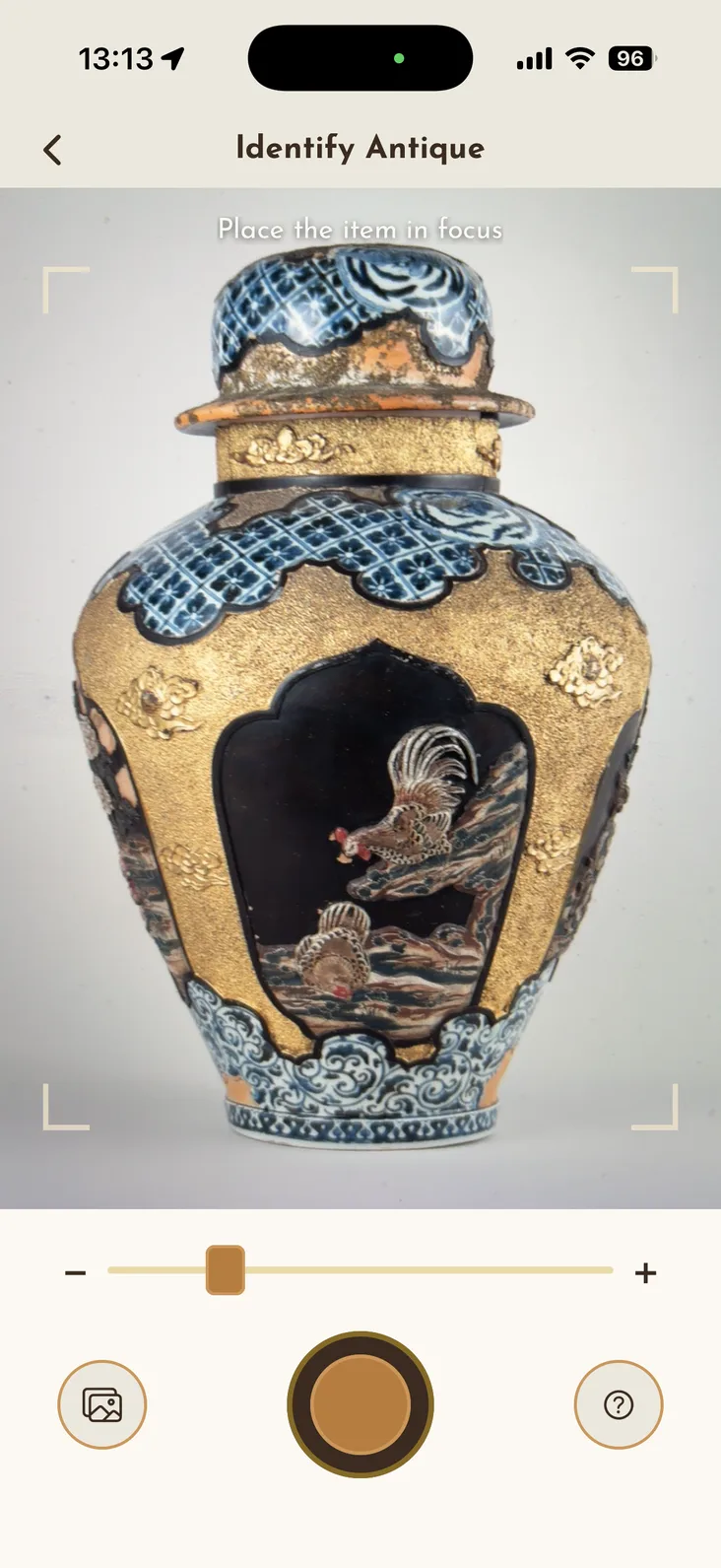
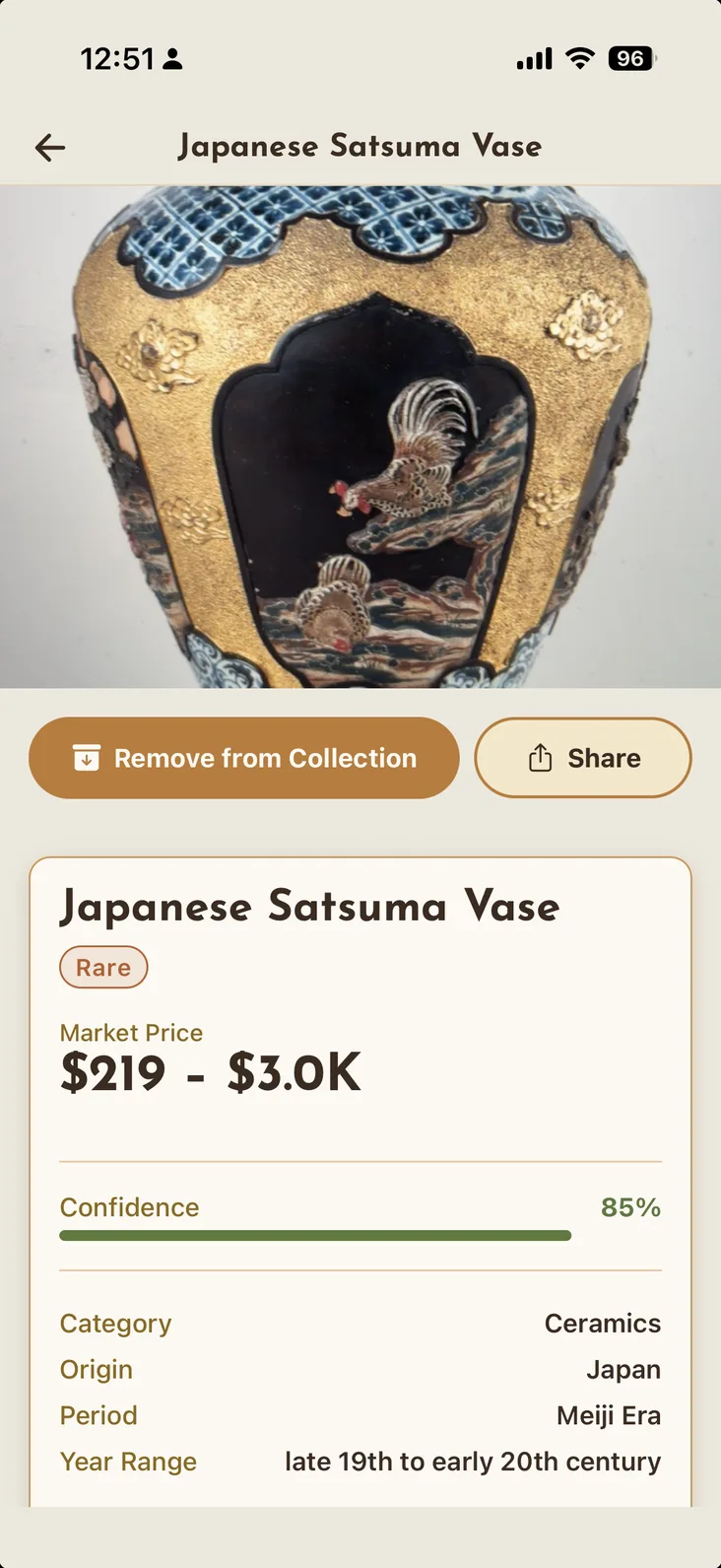
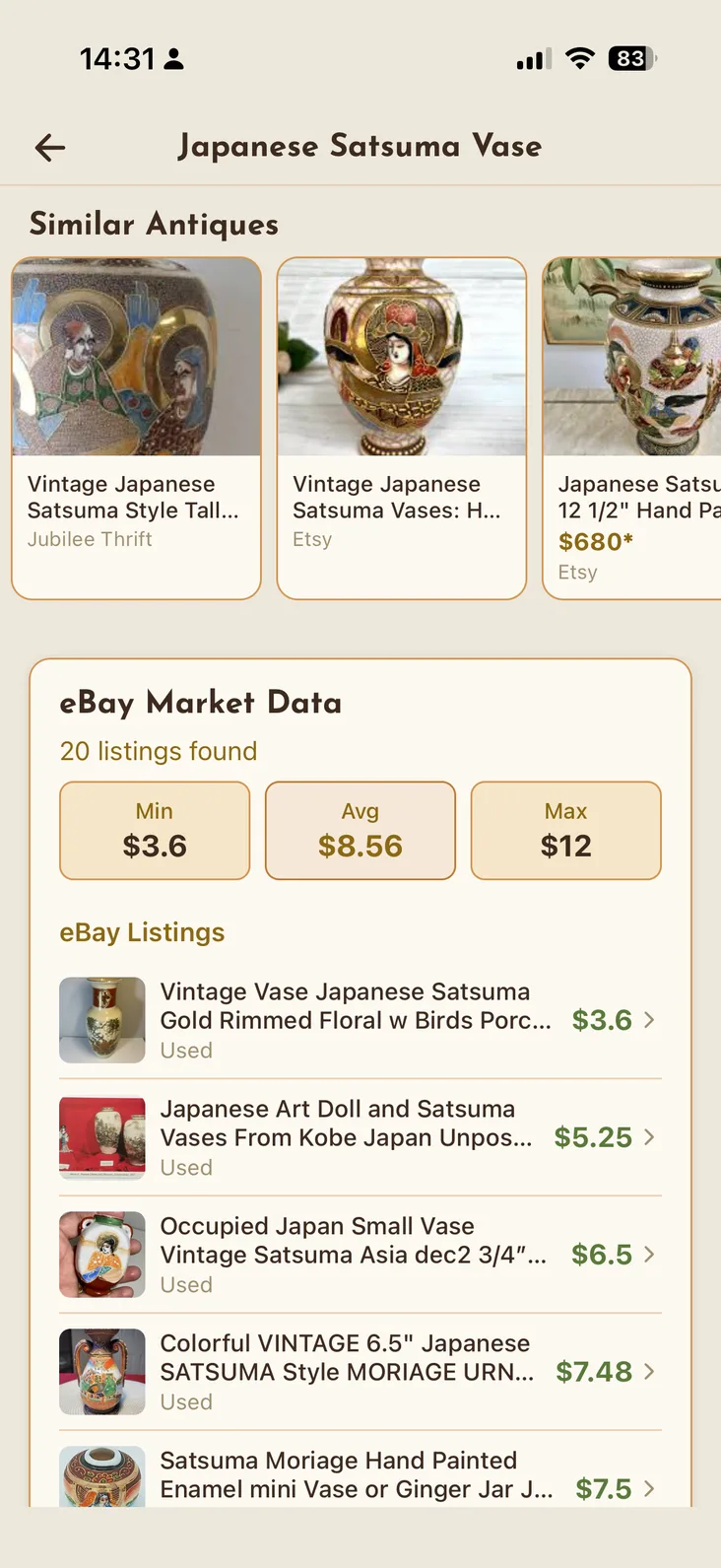
Values in the app are AI-generated estimates, not certified appraisals, based on similar items listed for sale at the time of the search. For insurance, probate or a sale, consult a qualified appraiser. Our guide to antique value apps explains how to read the range.
Frequently asked questions
Start with the wording on the base. "Nippon" usually means 1891 to 1921, "Japan" or "Made in Japan" 1921 or later, and "Occupied Japan" 1947 to 1952. Then look for a maker's mark, such as Noritake's M in a wreath, and check that the piece fits the date. Our five-step identification method covers checks that work on any antique.
From 1891 to 1921. A US law from 1891 required imports to show their country of origin, and Japanese makers used "Nippon", the Japanese name for Japan. From 1921, goods sent to the US had to say "Japan" instead. Pieces sold elsewhere don't always follow this. Our pottery marks guide lists similar dating words for other countries.
Usually not much on their own. These pieces were made in large numbers between 1947 and 1952 and are easy to find, so most sell for small amounts. Uncommon figures and full sets in perfect condition do better, and chips or repairs lower the price. Our guide to what your antique is worth shows how to check real sale prices.
Look past the cross-in-a-circle mark, which appears on old and new pieces alike. Meiji-era Satsuma is marked in Japanese only, with a cream body, fine crackle in the glaze, careful painting and a dull sound when tapped. "Royal Satsuma" or "Made in Japan" on the base means a 20th-century piece. See how to tell if an antique is valuable before paying for an appraisal.
Yes, as a starting point. Antique Snap reads the mark from a photo, checks it against the shape, glaze and painting, and gives the maker, period and an estimated value range with a confidence score. A sharp close-up of the base works best. Values are estimates, not appraisals, so read how app values work first.
Find out what the mark on the base means.
Free to try · No account needed · Cancel anytime


On your computer? Scan with your phone camera to get the app.